8 Steps to Financial Wellness with New Worksheet Demo, November 2025 On-Demand Recording

Please click the play arrow above to watch this 30-minute on-demand webinar recording. To accompany the 8 Steps to Financial Wellness, we created an interactive worksheet / checklist for our clients. Use the form at the bottom of this page to request this checklist if you’d like to use it.

This webinar is presented by our advisor, Jenna Witherbee. You may use the button below to find the more in-depth video series that provides more detail step by step in one on-demand playlist.

View More In-Depth 8 Steps Video Series

8 Steps to Financial Wellness Overview

Our 8 Steps to Financial Wellness provides a structured approach to working towards financial stability and health

Step 1: Establish an emergency fund

Step 2: Set a goal to save at least 5% through your 401(k) Plan

Step 3: Develop your understanding of credit

Step 4: Pay down non-deductible debt by creating a budget

Step 5: Max out your Health Savings Account (HSA), if applicable

Step 6: Increase your 401(k) contribution annually until you reach 10%

Step 7: Save for higher education expenses through 529 Plan

Step 8: Pay off your home early

Importance of Financial Wellness

Financial wellness is crucial for overall health and well-being

  • Reduces stress and anxiety related to financial instability

  • Improves sleep quality and mental clarity

  • Supports physical health by enabling better healthcare and nutrition choices

  • Enhances emotional well-being and life satisfaction

Step 1: Establish an emergency fund

This bucket of money is not just for emergencies. If it is helpful, you can also think of it as an “opportunity fund.”

  • Aim to accumulate 3-6 months worth of expenses in your savings

  • Do not let unexpected expenses bust your budget. Examples include things like a car breakdown, loss of smartphone, pet emergency vet visit, etc.

  • Consider setting up automatic transfers into a completely separate account that is only for this emergency fund

Step 2: Set a goal to save at least 5% through your 401(k) plan

At a minimum, you should save at least enough in your 401(k) to receive the full employer match. If your company does not have a match, consider starting around 5% and eventually building to 10-15% savings.

  • Alternatives exist if your employer does not have a 401(k) benefit, or if you are self employed. This includes Simple IRA, SEP IRA, Traditional IRA and Roth IRA options.

  • Learn about pre-tax versus Roth savings options

  • Most 401(k) plans have mutual funds as the investment option.

  • The two main factors to consider when selecting your investments are your age and your personal risk tolerance

Step 3: Develop your understanding of credit

Credit plays a significant role in personal finance management

  • Credit can be a valuable tool but may lead to financial trouble if mismanaged​

  • Responsible use of credit builds a positive credit history

  • The 5 C’s of Credit: Character, Capital, Capacity, Credit History, and Collateral are key factors lenders consider

Step 4: Pay down non-deductible debt by creating a budget

Effective strategies for managing and reducing non-deductible debt

  • Create a budget to track income and expenses

  • Identify and reduce non-essential spending

  • Consider debt consolidation to lower interest rates

  • Consider using either the Lowest-Balance Approach or Highest-Interest Rate Approach for debt repayment

Step 5: Max out your HSA (Health Savings Account) if you are covered in a High Deductible Health Plan

HSAs provide tax advantages for medical expenses

  • Max out HSA contributions if covered by a High Deductible Health Plan

  • 2026 IRS limits: $4,400 for individuals and $8,750 for families

  • Contributions are tax-deductible, and funds can grow tax-free

Step 6: Increase your 401(k) contribution by 1% every year until you reach 10%

Gradual increases in retirement savings can significantly impact future wealth

  • Commit to increasing retirement contributions by 1% each year until reaching 10-15%

  • Small savings can accumulate significantly over time

  • Evaluate and adjust contributions annually, especially after receiving bonuses or a raise

Step 7: Save for higher education expenses through 529 Plan

529 Plans are effective for saving for education costs.

  • 529 accounts can be opened through various financial institutions

  • Contributions can be automated from bank accounts

  • Funds can be used for qualified education expenses, offering tax benefits

Step 8: Pay off your home early

Considerations for paying off a mortgage ahead of schedule

  • Assess overall financial health before making extra payments

  • Explore refinancing options for better interest rates

  • Weigh the benefits of paying off the mortgage against potential investment opportunities

Register for Upcoming 2026 Webinars

Please let us know if you would like the 8 Steps to Financial Wellness Worksheet PDF. Use the form to submit your request and we will send it to you in 1-2 business days. Note - You must be a client to receive this resource. Thank you for your interest.


Contact Our Team With Questions

Fiduciary Training 301 - Strategic Fiduciary Oversight for 401(k) Plans, October 2025 On-Demand Recording

Please click the play arrow above to watch this 30-minute on-demand webinar recording. We created a checklist for retirement plan sponsors to better understand if they are meeting expectations for strategic fiduciary oversight of their organization’s 401(k) plan. Use the form at the bottom of this page to request this checklist if you’d like to use it.

This webinar is presented by our advisor, Jenna Witherbee. It is the third of three in our 2025 Fiduciary Training series. You may use the button below to find all three trainings from 2025 - 101, 201, and 301 - in one on-demand playlist.

View all Three 2025 Fiduciary Training Videos


Below is an overview of what you’ll learn in Fiduciary Training 301 - Strategic Fiduciary Oversight for 401(k) Plans

Agenda - consists of more advanced concepts for Retirement Plan Sponsors

  • Brief Recap of 101 and 201

  • Investment Due Diligence at the Next Level

  • Plan Design Strategy

  • Insurance & Protection Layers

  • Documentation & Fiduciary File

  • Audit Readiness

  • Cybersecurity

Understanding Fiduciary Roles and Responsibilities

Fiduciaries are responsible for managing plans in the best interest of participants and beneficiaries. ​

  • Key duties include managing plan expenses, ensuring diversification of investments, and adhering to plan documents

  • Fiduciaries must act with care, skill, prudence, and diligence

Investment Policy Statement (IPS) Importance

The IPS outlines the investment strategy and guidelines for the retirement plan. ​

  • It ensures compliance with ERISA Section 404(c) and provides participants with control over their investments ​

  • The IPS includes provisions for a qualified default investment alternative (QDIA) to limit fiduciary liability

Revenue Sharing and Fee Structures

Understanding fee structures is crucial for transparency and cost management in retirement plans

  • Revenue sharing involves using expense ratios that include fees for recordkeeping and advisory services

  • Zero revenue sharing funds provide greater transparency and are increasingly utilized in larger plans

Plan Design Strategy for 401(k) Plans

A well-structured plan design can enhance employee benefits and support business goals.

  • Key elements include eligibility, employer contributions, distributions, and automatic features like auto-enrollment

  • The primary goal is to attract and retain talent while ensuring adequate retirement savings for employees​

Insurance and Protection Layers for Fiduciaries

Fiduciaries should consider insurance options to mitigate risks associated with plan management.

  • ERISA fidelity bonds are required to protect against employee fraud, covering 10% of plan assets up to $500,000 ​

  • Fiduciary insurance is advisable but not mandatory, providing additional protection for plan administrators

Documentation and Audit Readiness

Maintaining thorough documentation is essential for compliance and audit preparedness.

  • The fiduciary file should include plan documents, investment monitoring records, fee disclosures, and meeting minutes ​

  • Regular audits by the DOL and IRS ensure compliance with ERISA and tax regulations

Cybersecurity Considerations for Retirement Plans

Cybersecurity is a critical aspect of protecting participant data and plan integrity.

  • Due diligence on service providers and ongoing monitoring of cybersecurity practices are necessary

  • Documentation of cybersecurity measures is essential for compliance and risk management

Optional Fiduciary Training and Credentials

Fiduciary Essentials® for Defined Contribution Plans offers additional training for fiduciaries.

  • The program includes three sessions, quizzes, and a course assessment to enhance fiduciary decision-making

  • Resources such as checklists and compliance calendars are provided to support fiduciaries

Upcoming Webinars and Educational Opportunities

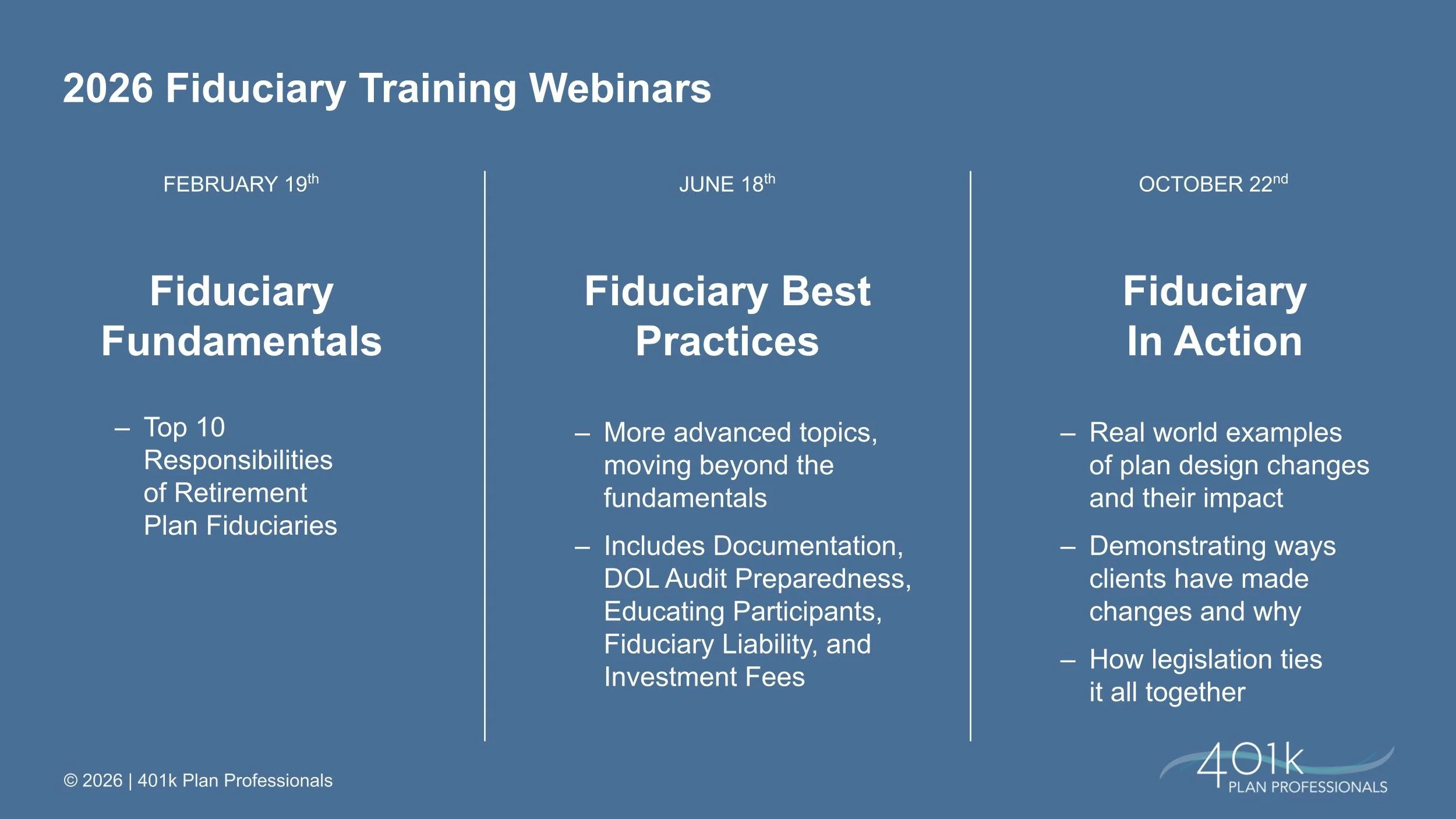
We have 16 webinars scheduled for 2026. Our aim is to provide ongoing, relevant education for plan sponsors and participants. You may register for all of those trainings today by visiting our “On-Demand Education” tab at the top of our website.

  • The next Fiduciary Training webinar for plan sponsors is on February 19th, 2026 - use the button below to register today

Register for 2026 Fiduciary Training 101

Please let us know if you would like the Strategic Fiduciary Oversight of your 401(k) Plan Checklist PDF. Use the form to submit your request and we will send it to you in 1-2 business days. Thank you for your interest.


Contact Our Team With Questions

Minnesota Paid Family Medical Leave & Employment Law Update, September 2025 On-Demand Recording

Please click the play arrow above to watch this 30-minute on-demand webinar recording.

We are grateful to Genevieve Frazier with Maguire Agency and Evon Spangler with Spangler & de Stefano, PLLP for co-hosting this timely update for Minnesota Paid Family Medical Leave and related employment laws.

Genevieve Frazier with Maguire Agency and Evon Spangler with Spangler & de Stefano, PLLP

Contact Genevieve Frazier
Contact Evon Spangler

Agenda

  1. Paid Family Medical Leave - what you need to know and do now

  2. Employment Law Update - PFML vs. ESST

  3. Employment Handbook - what you need to know and do now

Below is a recap of what is covered in the on-demand recording.

Minnesota Paid Family Medical Leave Overview

The Minnesota Paid Family Medical Leave (PFML) program is set to provide paid leave benefits to employees starting January 1, 2026. ​ Payroll deductions for employers and employees begin on January 1, 2026. ​ Premiums are due by April 30, 2026, based on wages from the first quarter of 2026. ​ All employers with employees in Minnesota are required to participate. ​ Employees become eligible after 90 days of employment, with exceptions for independent contractors, federal employees, self-employed individuals, and certain seasonal workers. ​

Employee Eligibility and Coverage Details

Eligibility for the PFML program is determined by the employee's work location and duration of employment. An employee's work is considered covered if 50% or more is performed in Minnesota. Employees must have worked at least 80 hours in a year to qualify. ​ Independent contractors and certain seasonal employees are excluded from eligibility. ​

Funding Structure for Paid Family Medical Leave

The PFML program will be funded through a payroll tax system, with specific rates for different employer sizes. The initial payroll tax rate is set at 0.88%, with a maximum annual premium rate of 1.1%. ​ Small employers (30 or fewer employees) will have a reduced rate of 0.44%. ​ Contributions can be split equally between employers and employees, with a maximum weekly contribution of $14.90 each ($29.80 per week in total).

Benefits and Leave Duration Under PFML

Employees are entitled to a maximum of 20 weeks of paid leave per year, with benefits based on income levels. ​ Employees earning 50% or less of the statewide average weekly wage (SAWW) receive 90% of their wages. ​ Those earning between 50% and 100% of the SAWW receive 66%, while those earning above 100% receive 55%. ​ Leave can be taken for personal health conditions, family care, or safety leave, with a maximum of 12 weeks for each category. ​

Filing Claims and Benefit Eligibility

The process for filing claims and determining eligibility for benefits is clearly outlined. Claims must be based on a qualifying event lasting at least seven consecutive days. ​ Benefits take effect on the Sunday of the week when the application is submitted. ​ Employees can request retroactive payment for benefits if they were incapacitated or unable to apply on time. ​

Anti-Retaliation Protections Under PFML

The PFML law includes protections against employer retaliation for employees exercising their rights. Employers cannot discharge, discipline, or discriminate against employees for requesting leave or benefits. ​ Employers must not obstruct the application process for leave or benefits. ​

Comparison of Paid Family Medical Leave (PFML) and Earned Sick and Safe Time (ESST)

The PFML program differs from the Earned Sick and Safe Time (ESST) in several key areas. PFML provides job protections and partial wage replacement for qualifying conditions lasting at least seven days, while ESST allows for paid time off for various reasons. ​ PFML starts on January 1, 2026, while ESST is already in effect as of January 1, 2024. PFML offers up to 20 weeks of leave, compared to ESST's maximum of 48 hours per year. ​

Employee Handbook Updates Required

Employers need to revise their employee handbooks to comply with new PFML regulations. Review and update time-off policies to align with PFML requirements. ​ Ensure that the handbook includes mandatory provisions related to PFML and ESST. ​ Employers cannot require employees to exhaust other leave types before taking PFML.


Please let us know if you would like a copy of this PDF presentation sent to you. Use the form to submit your request and we will send it to you in 1-2 business days. Thank you for your interest in Minnesota Paid Family Medical Leave and Employment Law.


Schedule a 1-1 with an advisor
Contact Our Team With Questions

My Brain Made Me Do It: Strategies for Better Investment Decisions, September 2025 - On-Demand Recording

Please click the play arrow above to watch this 45-minute on-demand webinar recording.

Our advisor, Gina Buchholz, presents “My Brain Made Me Do It: Strategies for Better Investment Decisions.”

This presentation provides an opportunity to:

  • Investigate how we typically make decisions

  • Understand how our decision-making process contributes to common investment mistakes

  • Learn how to train our brains to avoid those mistakes

Additionally, you’ll learn about these six common investing mistakes:

  • Loss aversion

    • This is an emotional bias

    • Some financial decisions that are driven by loss aversion include reluctance to sell losing investments, selling winning investments too early, excessive risk aversion, and inaction bias

    • Consider Dollar Cost Averaging

  • Anchoring

    • This is a cognitive bias

    • Anchoring is how well you can concentrate and focus

    • Some financial actors include the Great Depression in the 1930s, the market crash in the 1970s, significant inflation in the 1980s, the Dot-Com Bubble Burst, the Great Recession of 2008, and the Covid-19 Pandemic Downturn

    • You can change your anchors by reviewing the S&P 500 Index data

  • Status quo bias

    • This is a cognitive bias

    • People tend not to change an established behavior unless the incentive to change is compelling

    • Consider asset allocation and rebalancing

  • Procrastination

    • This is an emotional bias

    • Ways to remedy procrastination include making a schedule, revisiting your plan at regular intervals, involving others and holding yourself accountable, learning what motivates you, rewarding yourself for progress toward your goals

  • Hindsight bias

    • This is an emotional bias

    • Hindsight is like locking the barn door after the horse has run away aka taking action after it is too late

    • It is natural to feel emotional about your investments. Common feelings include feeling confident, euphoric, desperate, nervous, defeated, and hopeful

    • Emotions tend to make investors abandon and reenter stocks at the worst times

    • It is important to understand time, diversification, and the volatility of returns

    • Ways to remedy hindsight bias include remembering that you did the best you could with the information you had, reviewing your plan to make sure it still works for you, keeping a long-term perspective, and writing a letter to yourself

  • Availability

    • This is a cognitive bias

    • Think of this as people’s tendency to use the information that’s on hand to make decisions

    • Ways to remedy this include not believing everything that you hear, remembering that bad news sells newspapers and media in general, experts (and your neighbors and friends) can be wrong, systematic investing works in up and down markets


Schedule a 1-1 with an advisor
Contact Our Team With Questions

2025 Retirement Plan Sponsor Fiduciary Training, On-Demand Recordings

As your retirement plan advisor, we provide you and your team with continuous education to support your role as both a plan sponsor and a fiduciary to your organization’s retirement plan.

This three-part fiduciary-focused webinar series is for any retirement plan sponsor looking to refresh their knowledge or onboard into that role for the first time.

Each on-demand video is about 30-minutes and it is presented by our advisor, Jenna Witherbee. To watch the playlist above, click on one of the videos to begin.

2025 Fiduciary Training 101: Your Role as a Fiduciary + Basic ERISA Fiduciary Duties + Administrative Best Practices + Educating and Empowering Participants

2025 Fiduciary Training 201: Hot Topics for Fiduciaries

—Plan Sponsors face an ever-changing landscape and this session focuses on what should be top of mind today and into the future for retirement plan sponsors

2025 Fiduciary Training 301: Strategic Fiduciary Oversight for 401(k) Plans

--Includes a brief recap of 101 and 201, Investment Due Diligence at the Next Level, Plan Design Strategy, Insurance & Protection Layers, Documentation & Fiduciary File, Audit Readiness, and Cybersecurity Considerations

Watch 101 Here
Watch 201 here
watch 301 here
Contact Us with questions

Medicare 101 Webinar - August 2025 - On-Demand Recording

Please click the play arrow above to watch this 1-hour on-demand webinar recording.

We are grateful to Ron Bezis of Manulife John Hancock Investments for presenting this important Medicare information. See below to receive a Q&A Guide PDF to accompany this education.

This presentation covers the following areas of Medicare:

  • Medicare's History

  • The Parts of Medicare

    • Part A - Hospital Coverage

      • Think of this like room and board

    • Part B - Outpatient Coverage

    • Part C - Medicare Advantage

      • Private insurance plans that pay instead of Medicare

    • Part D - Voluntary Drug Program

      • Think of this as your pharmacy card

  • When to Enroll

    • IEP - Initial Enrollment Period = a 7 month window before and after your 65th birthday (3 months before and 3 months after)

      • For example: If you turn 65 on May 20, your Medicare IEP would run from February 1 to August 31

  • Medicare Cost Sharing

  • Covering the Gaps

    • Medigap

      • Higher premiums, less cost-sharing

    • Medicare Advantage

      • Lower premiums, higher cost-sharing

  • Working Past Age 65


To receive an additional Medicare Q&A Guide PDF, please fill out this form and we will email you the file within 2 business days.


Next Steps - Additional Medicare information resources

The Centers for Medicare and Medicaid

Phone: 1-800-MEDICARE

Website: https://www.medicare.gov/

Medicare Website

Social Security Administration

Phone: 1-800-772-1213

Website: https://www.ssa.gov/

Social Security Website

Under 65 health plans

Phone: 1-800-318-2596

Website: https://www.healthcare.gov/

Healthcare.gov Website

Pooled Employer Plans (PEPs) + 401k Collective On-Demand Recording, August 2025

Pooled Employer Plans are one option for your organization’s retirement plan benefit. This webinar, hosted by our advisor - Jenna Witherbee - is a 30-minute overview of PEPs aka Pooled Employer Plans. Jenna also discusses the recently launched 401k Collective PEP that provides a solution to work with our team as an alternative to the state mandate program.

Today’s agenda includes:

  1. Pooled Employer Plans (PEPs)

  2. State Mandated Programs

  3. Ideal PEP Candidates and Success Stories

  4. Additional Resources for Retirement Plan Sponsors

Note: Please feel free to share this recording with any retirement plan sponsor / fiduciary to an organization’s retirement plan. Our education series is meant to be shared.

If you’d like to learn more about the 401k Collective PEP that gives you access to our team and service model, click the button below.

401k Collective PEP

Contact Us with Questions

Social Security 101 On-Demand Recording, July 2025

We are joined by Zach Lindsay and Jack Wood of MFS Investment Management for this year’s Social Security 101 Webinar. This webinar is for everybody - both employees and employers. The on-demand recording above is a 45 minute presentation with an additional 30 minutes at the end answering audience questions.

Remember: Social Security benefits are not intended to be your only source of income when you retire

Today’s agenda includes:

  1. How retirement benefits are calculated

    1. Social Security benefits are based on your Full Retirement Age

  2. Options for married couples and divorcees

    1. Spousal benefits and how to calculate spousal benefits

    2. Survivor Benefits

    3. Remarriage and Social Security

  3. Taxes and your retirement plan

    1. Combined income determines if Social Security benefits are taxable

      1. AGI + Tax-Exempt Income + Half of Social Security = Combined Income

    2. Medicare Part B and D premiums

Note: Please feel free to share this recording with any employer or employee who may benefit from our continuing education. This specific webinar is for everyone.

If you’d like to receive additional Social Security PDF resources, please submit the web form below and we will email the PDFs to you in 1-2 business days.

The available PDFs cover the following four topics:

  • 2025 Social Security Reference Guide

  • Social Security Spousal Benefits FAQ

  • Social Security Benefits for Widows and Widowers FAQ

  • Social Security Divorced Spouse Benefits FAQ


Contact Us with Questions

Fiduciary Training 201 Webinar: Hot Topics for Fiduciaries, June 2025 On-Demand Recording

We upgraded this year's 3-Part Quarterly Fiduciary Training Series, designed specifically for retirement plan sponsors.

201 is the second of the three trainings for 2025. This 28-minute webinar focuses on Hot Topics for Fiduciaries and it will help you up-level your knowledge as a fiduciary to your organization’s retirement plan.

Our advisor, Jenna Witherbee, discusses the following three fiduciary topics in this 201 training for 2025:

  1. Legislative Update

    1. SECURE 2.0 - What’s Happening Now?

      1. Roth Catch-up for High Income Earners

      2. Expanded Withrdrawal Options

      3. Long-term, Part-time Employees

      4. DOL Lost and Found Database

      5. Progress with Student Loan Debt Solutions

    2. SECURE 3.0 - What’s Next?

    3. Forfeiture Litigation

    4. State Mandates

  2. Pooled Employer Plans (PEPs) + the 401k Collective PEP

  3. Building Financial Confidence Through Education

Note: Please feel free to share this recording with any plan sponsor who may benefit from our continuing education. This specific webinar is not for retirement plan participants.

Watch 2025 Fiduciary Training 101 Here
Contact Us with Questions

Navigating Federal Student Loans in 2025, On-Demand Recording

We are joined by Bill Harmon, Beth Krasnow, and Aaron Longino with Thrive for this 30-minute webinar.

This webinar covers the following:

  • How to Enroll in IDR

  • Understand the Current Program Changes

  • Handle Forbearance & Default

  • Qualify for Forgiveness

Additionally, this webinar will help you understand and take advantage of recent federal loan changes. You’ll learn:

  • Which Income-Driven Repayment (IDR) plans are staying, which are ending, and how to choose what fits best

  • How to get out of forbearance or default and protect progress toward forgiveness

  • What is the Buyback program, who qualifies, and how it works

  • How to qualify for TEPSLF

  • How to be eligible for loan forgiveness, including new updates

  • What the Department of Education, Congress, and the Courts are changing—and what’s not changing


Opportunity for 1-1 Guidance with Thrive

You may sign up for a complimentary one-on-one loan review with a Thrive advisor to get personalized guidance.

Schedule Today

Our team is committed to supporting you with resources that make a real difference. If you’ve got Federal student loans, this is a great opportunity to get clear, expert help.


Please note: If you’d like to discuss your retirement plan or any other financial matter with one of our advisors, please call us or use the button below to schedule a 1-1 with our team. We are here to help.

Schedule a 1-1 Here
Contact Us with Questions

8,000 Days of Retirement Webinar with MIT AgeLab Research, On-Demand Recording

We are joined by John Diehl with Hartford Funds for this webinar. John Diehl, Senior Vice President of Applied Insights at Hartford Funds, explains how your life can be divided into four 8,000-day segments and highlights what's most important in each.

For more than a decade, Hartford Funds has partnered with the MIT AgeLab to uncover what investors are thinking about lifestyle trends, who they trust, and the future of retirement—all of which influence their decision-making process. In this 1-hour webinar, John Diehl uses AgeLab research to dive deeper into what retirement looks like in reality.

Short Retirements Are No Longer the Norm

Retirement is no longer a relatively brief time of leisure after work ends. With today’s increasing lifespans, clients face roughly 20 or more years in retirement, or about 8,000 days. Viewed this way, it becomes clear that retirement is not an end, but a new, complex, and unpredictable phase of life, filled with potential.

Preparing for an 8,000-Day Retirement

It’s often asked, “What are you going to do when you retire?” Most individuals have a clear image of day one, maybe even day 1,001. But few can imagine 8,000 days of golf, and even fewer have a vision of what they will be doing on any given day—such as day 4,567.

Instead of planning for an undefined stretch of time, it may be more beneficial to conceptualize retirement as four distinct phases, each characterized by different opportunities and challenges

  • The Honeymoon Phase

  • The Big Decision Phase

  • The Navigating Longevity Phase

  • The Solo Journey Phase

Ask yourself, given the prospect of an 8,000+ day retirement, do you think you are as prepared psychologically for retirement as you are financially?


If you’d like the 12-page white paper PDF for this presentation, please submit the web form below and we will email it to you in 1-2 business days.


Please note: If you’d like to discuss your retirement plan or any other financial matter with one of our advisors, please call us or use the button below to schedule a 1-1 with our team. We are here to help.

Schedule a 1-1 Here
Contact Us with Questions

Navigating Market Volatility & Uncertainty - April 10, 2025 - On-Demand Recording

Additional J.P. Morgan Resources Here: Navigating market volatility: A guide for retirement investors

Our guest webinar presenter, Marta Rodriguez with J.P. Morgan Asset Management, joins us for a 34-minute webinar to provide insight into the recent market shifts in early April 2025. Marta is our long-time partner who has a gift for simplifying the complex world of economics. She always brings a fresh and analytical perspective to an often emotionally-charged and challenging topic for audiences.

Watch this 34-minute webinar (speaker content begins at 2:08 mark) to hopefully give you peace of mind in today’s geopolitical and economic climate. Marta covers the following in her presentation :

  • Components of GDP growth

    • Contributors to real GDP growth

  • Unemployment and wages

    • Civilian unemployment rate and year-over-year wage growth

  • Sources of earnings growth and profit margins

    • S&P 500 year-over-year pro forma EPS growth

    • S&P 500 profit margins

  • Inflation components U.S.

    • Contributors to headline CPI inflation

  • Tariffs on U.S. imports

    • Average tariff rate on U.S. goods imports for consumption

  • Labor Supply

    • Nonfarm payroll gains

    • Labor force growth, native and immigrant contributions

  • Federal finances

    • The 2025 federal budget

    • Federal deficit and net interest outlays

    • Federal net debt (accumulated deficits)

  • The Fed and interest rates

    • Federal funds rate expectations

  • Credit market dynamics

    • Corporate credit spreads

    • U.S. high yield by credit rating

    • U.S. high yield default rates

  • S&P 500 valuation measures

    • S&P 500 Index: Forward P/E ratio

  • Global equity markets

    • Share of global market capitalization

  • Annual returns and intra-year declines

    • S&P intra-year declines vs. calendar year returns

  • Consumer confidence and the stock market

    • Consumer Sentiment Index and subsequent 12-month S&P 500 returns

  • Time, diversification, and the volatility of returns

    • Range of stock, bond, and blended total returns


Please note: If you’d like to discuss your retirement plan or any other financial matter with one of our advisors, please call us or use the button below to schedule a 1-1 with our team. We are here to help.

Schedule a 1-1 Here
Contact Us with Questions

2025 Retirement Plan Sponsor Fiduciary Summit - You're Invited

You are invited to our 12th Annual Retirement Plan Sponsor Fiduciary Summit on Wednesday, April 23, 2025!

This is an in-person 1/2 day event filled with speakers and educational content to empower you in your role as a plan sponsor for your organization’s retirement plan.

NOTE: Clients and prospective clients are all welcome to join us - we would love to have you.

The agenda is below, along with a calendar form to register for the event. Please register in advance so that we have proper headcounts for food and space. Breakfast, lunch, and snacks will be served. The location is The Club at Golden Valley in Minneapolis, Minnesota.

Contact us with any questions

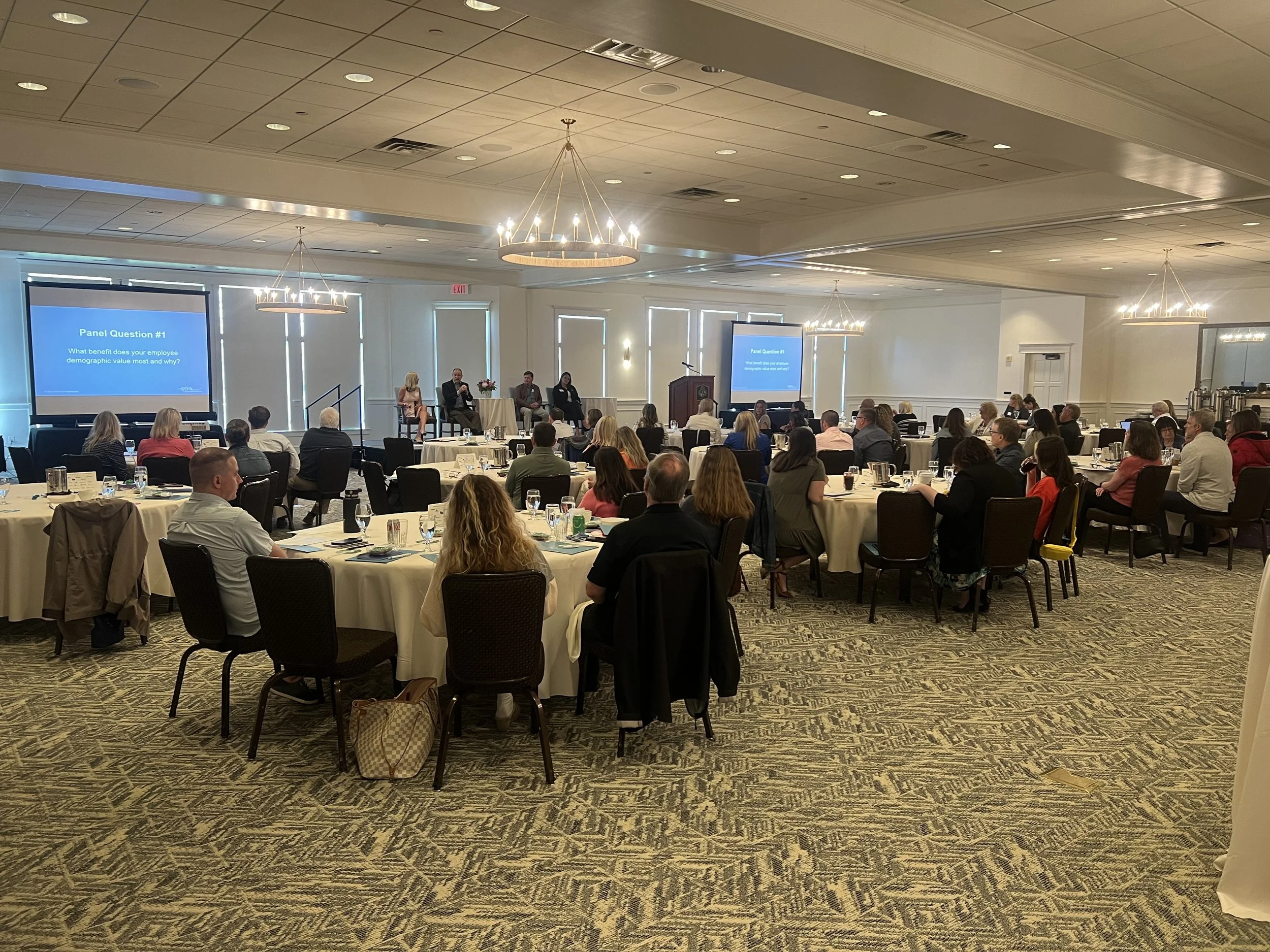
2024 Plan Sponsor Fiduciary Summit at The Club at Golden Valley in Minneapolis, Minnesota with our clients and partners

Level Up Your Organization's LinkedIn Game, On-Demand Recording

Our guest webinar presenter, Jennifer Chenoweth, has over 20 years of experience working in Fortune 50 companies across marketing, sales, and HR. Her presentation is titled, “Level Up Your Organization’s LinkedIn Game.”

Watch this 28-minute webinar (speaker content begins at 2:30 mark) to learn more about optimizing your organization’s LinkedIn presence. We have also included the actionable document with 10 Ways to Activate Employees on LinkedIn & Strengthen Your Organization’s Brand. If you’d like this sent to you as a PDF, please fill out the web form below.

Webinar Overview

  1. LinkedIn’s Role Beyond Hiring – How LinkedIn can be leveraged for talent acquisition, employer branding, employee engagement, and retention.

  2. Employee Engagement on LinkedIn – How to equip employees with the right tools—headshots, branded assets, and best practices—to strengthen their presence and participation.

  3. Integration of LinkedIn into Onboarding & Retention Strategies – How welcoming new employees on LinkedIn and encouraging internal connections helps create a connected and engaging culture.

  4. Company Page Content Strategy that Resonates – How employee-driven content—spotlights, career growth stories, and cultural highlights—creates a compelling LinkedIn presence that attracts and retains top talent.

If you’d like a PDF of these 10 tips, please submit the web form below and we will email it to you in 1-2 business days.


Contact Us with Questions

Fiduciary Training 101 Webinar, February 2025 - Your Role as a Fiduciary, Basic ERISA Fiduciary Duties, Administrative Best Practices, & Educating & Empowering 401(k) Participants

We upgraded this year's 3-Part Quarterly Fiduciary Training Series, designed specifically for retirement plan sponsors.

The first of the three trainings for 2025 is 101. This 33-minute webinar is a great refresher if you are more seasoned in your role as a fiduciary to your organization’s retirement plan, and a great foundation if you are new to your role and need a starting point.

Our advisor, Jenna Witherbee, discusses the following four fiduciary topics in this 101 training for 2025:

  1. Your Role as a Fiduciary

  2. Basic ERISA Fiduciary Duties

  3. Administrative Best Practices

  4. Educating & Empowering 401(k) Participants

Note: Please feel free to share this recording with any plan sponsor who may benefit from our continuing education. This specific webinar is not for retirement plan participants.

Contact Us with Questions

2025 Retirement Planning Considerations + Market Update

Jenna Witherbee discusses retirement planning considerations for 2025, including ways to save and new limits, notable 2024 deadlines, pre-tax vs Roth contributions, and ways to get back on track.

And one of our regular guest presenters, Marta Rodriguez, with J.P. Morgan Asset Management, provides a timely market update for January 2025.

Contact Us with Questions

2024 Fiduciary Training, On-Demand Recordings

As your retirement plan advisor, we provide you and your team with continuous education to support your role as both a plan sponsor and a fiduciary to your organization’s retirement plan.

This three-part fiduciary-focused webinar series is for any retirement plan sponsor looking to refresh their knowledge or onboard into that role for the first time.

Each part is about 25-minutes and it is presented by our advisor, Jenna Witherbee. To watch the playlist above, click on one of the videos to begin.

Part 1: Your Role as a Fiduciary + Basic ERISA Fiduciary Duties

Part 2: Overseeing Investments + Overseeing Service Providers

Part 3: Helping Participants + Plan Administrator Basics + Fiduciary Liability, DOL Audit, FIduciary Insurance and Bonding

Contact Us with questions